A low appraisal feels like a crisis, but under California's standard contract it is a negotiation with a clock on it, and Orange County's softening market gives buyers more room than they think.

Every buyer in Orange County eventually hears a version of the same sentence from their lender: the appraisal came in below the price you agreed to pay. It is one of the most stressful moments of a purchase, and it is also one of the most misunderstood. In California's standard purchase agreement, a low appraisal is not the end of the deal. It is the start of a short, structured negotiation, and the buyer holds more of the cards than most people realize.
Why Orange County Home Prices Make This Matter Now
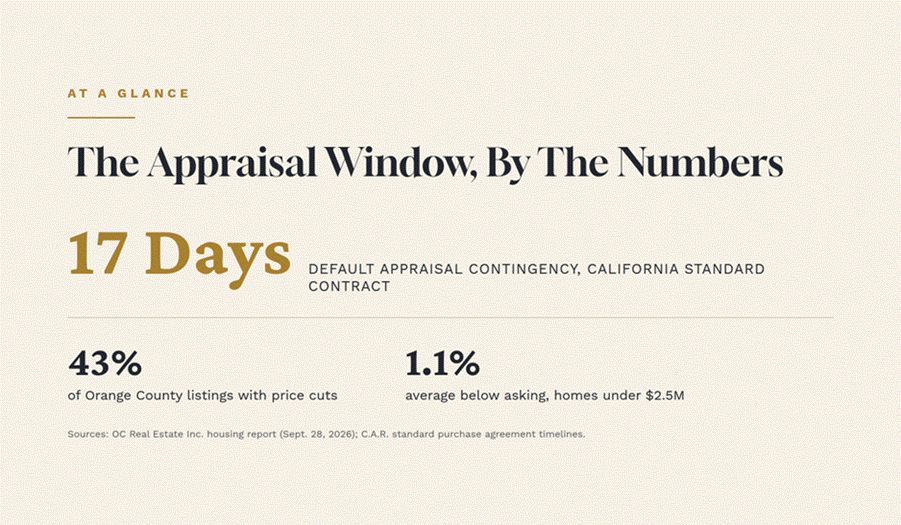
Appraisals tend to bite hardest when prices are moving. According to the September 28 snapshot from OC Real Estate Inc., 43 percent of active Orange County listings have taken a price reduction, the average home has sat 66 days, and homes under $2.5 million are closing an average of 1.1 percent below asking. The median single-family closed price is $1,400,000. When sellers are cutting prices, asking prices and recent sold comparables can drift apart, and appraisers must rely on the sold comparables. Add a 30-year fixed rate that Fortune reports at 7.455 percent today, up from 7.373 percent yesterday, and buyers have very little cushion in their budgets to absorb a surprise.
How the Appraisal Gap Actually Works
A lender will only finance a percentage of the appraised value or the purchase price, whichever is lower. Consider an illustrative example. A buyer agrees to pay $1,400,000 and plans to put 20 percent down, which is $280,000. The home appraises at $1,350,000. The lender now lends 80 percent of $1,350,000, or $1,080,000. To close at the agreed price, the buyer needs $320,000 in cash, which is $40,000 more than planned. That shortfall is the appraisal gap, and the buyer cannot simply ignore it.
The Seventeen-Day Clock
In the California Association of Realtors standard contract, the appraisal contingency defaults to 17 days after acceptance, while the loan contingency runs 21 days. Those timelines are negotiable, and they matter enormously. As long as the contingency is still in place, a buyer can ask for a price reduction, bring extra cash, or cancel and protect the deposit. Once the contingency is removed, those protections weaken, and a low appraisal can put the deposit at risk. Many buyers remove contingencies early to look strong in an offer. In the current Orange County market, where homes are taking longer to sell, that is often a risk that does not need to be taken.
Your Four Options When the Number Comes In Low
The first and most common path is to renegotiate. You bring the appraisal report to the seller and ask for a price that matches the appraised value, which works best when the seller has already been sitting on the market for weeks. The second is to cover the gap in cash, which makes sense only if you have reserves and still believe the home is worth what you agreed to pay. The third is to challenge the appraisal by asking the lender for a reconsideration of value, supported by stronger comparable sales. Appraisers review new evidence but are not obligated to change their opinion, and the process can take a few days to a week, so start immediately. The fourth is to cancel under the contingency and recover your deposit, provided you act inside the window.
What Sellers Should Understand
Sellers sometimes assume a low appraisal is the buyer's problem. It rarely is. If a deal falls apart over an appraisal, the next buyer's lender will usually order its own appraisal and may reach a similar number, and the home picks up more days on market along the way. In a county where the average listing is already at 66 days, a seller who meets the appraisal halfway often nets more than one who relists. Pricing correctly from the first day is the best protection, whether you are selling in Mission Viejo, Irvine, or Huntington Beach.
Three Steps to Take Before You Make an Offer
First, ask your agent to review recent sold comparables, not just active listings, so you know where an appraisal is likely to land. Second, decide in advance how much extra cash you could comfortably bring, and write that number down before emotions get involved. Third, keep your appraisal contingency in place unless you have a clear reason and a clear reserve. A skilled agent can often make an offer competitive through timing, flexibility, and communication rather than by giving up protections.
Buying or selling in Orange County should feel informed, not stressful. If you would like to talk through how these timelines apply to your situation, I am always glad to help. I'm Parisa Houshangi, 25+ years of experience serving Orange County, and proud to rank in the top 1.5% of real estate agents nationwide.
Parisa Houshangi
Keller Williams · OcBeautifulHomes.com · DRE# 01314175
Data: OC Real Estate Inc. housing report (Sept. 28, 2026); Fortune mortgage rates (Sept. 30, 2026); C.A.R. standard purchase agreement timelines via Cooper Family Real Estate and Laffins Real Estate. The $1.4M example is illustrative and not legal or financial advice.