Should You Lock Your Mortgage Rate? What Orange County Home Buyers Need to Know After This Week's Jump
Rates climbed from 7.11% to 7.28% in a single week. Here is how a rate lock works, what it can cost, and how to time it on an Orange County purchase.
By Parisa Houshangi
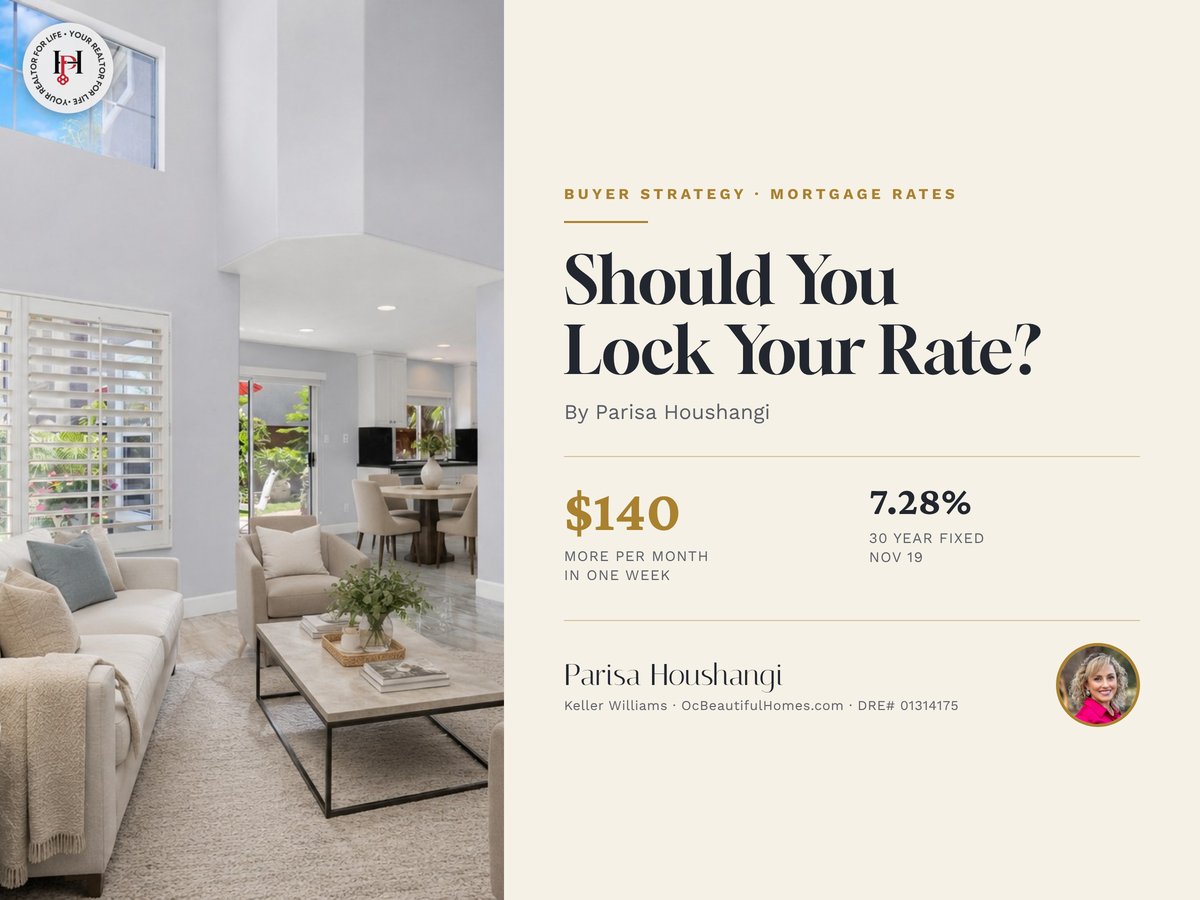
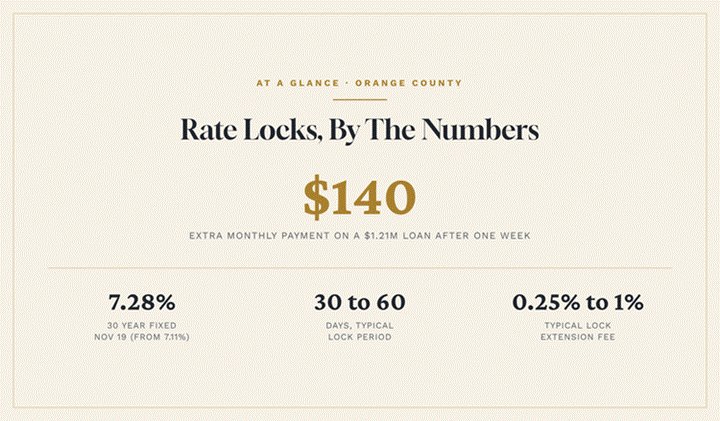
For four straight weeks, mortgage rates drifted lower, and plenty of buyers decided to wait for a little more relief. Then the latest Freddie Mac survey, released November 19, showed the 30 year fixed average back up to 7.28%, from 7.11% the week before. With Orange County home prices where they are today, a move that size is not a rounding error.
The median closed single family price in the county's latest weekly housing report was $1,517,500. Put 20% down and you are borrowing about $1,214,000. At 7.11%, the principal and interest payment on that loan is roughly $8,167 a month. At 7.28%, it is roughly $8,306. That is about $140 more every month, for thirty years, from one week of movement. This is exactly the situation a rate lock is built for.
What a Rate Lock Actually Does
A rate lock is your lender's promise that your interest rate will not change between the loan offer and closing, as long as you close within the lock period and nothing changes on your application. The Consumer Financial Protection Bureau says locks are typically available for 30, 45, or 60 days, and sometimes longer. You can confirm whether your rate is locked, and until what date, on page 1 of your Loan Estimate.
That second condition matters more than most buyers realize. The CFPB notes that a locked rate can still change if your loan amount changes, if your credit score changes, if the lender cannot verify income such as overtime or bonus pay, if the appraisal comes in higher or lower than expected, or if you switch loan types or change your down payment. In other words, the lock protects you from the market, not from changes in your own file.
Protection Versus Flexibility
Locking has a trade off. The same CFPB guidance points out that a lock may keep you from getting a lower rate if rates fall after you receive your loan offer. Some lenders offer a float down option that lets you capture a lower rate if the market improves, but it is rarely free. Experian puts typical float down fees at 0.5% to 1% of the loan amount, and terms vary widely from lender to lender, so ask for them in writing before you rely on one.
Choosing to float means you are betting on the direction of rates. This week showed how quickly that bet can go the wrong way. The county's weekly report noted that daily rate trackers moved up about three tenths of a point in a week, with readings between roughly 7.3% and 7.5% depending on the survey. Your own quote will depend on your credit, down payment, and loan type, but the direction was the same everywhere.
Match the Lock to Your Escrow, Not Your Hopes
The most expensive rate lock mistake is choosing a lock that ends before your escrow does. Experian notes that closings usually happen 30 to 60 days after an offer is accepted, and that a 45 or 60 day lock may cost less than choosing 30 days and paying to extend it later. Bankrate reports that extension fees run anywhere from 0.25% to 1% of the loan principal, though many lenders charge a flat fee instead. On a $1,214,000 loan, 0.25% is $3,035 and 1% is $12,140.
Who pays for an extension often depends on who caused the delay. Bankrate says most lenders will not charge the fee when the lender caused the delay, and if the seller causes it, you can ask the seller to cover the cost. With Thanksgiving and the December holidays ahead, appraisers, escrow officers, and underwriters will all be working shorter weeks, so build a few extra days into your timeline. And once you are locked, avoid opening new credit or making large purchases. Bankrate warns that a change in your credit score or debt to income ratio can void the original lock.
What This Means in Today's Orange County Market
The November 16 Orange County housing report shows a market that gives buyers time without giving them unlimited time. Active listings stood at 4,878, while pending sales rose to 1,463, the first weekly increase since August. Median days on market reached 53, and homes under $2.5 million sold for an average of 1.7%, about $22,158, below their final list price. Condo and townhome buyers in Irvine, Mission Viejo, and across South County saw the median list price dip to $799,999.
That combination means you can negotiate on price and still protect your payment. Once you are in contract, talk with your lender the same day about lock length and cost. Waiting for a better rate while you negotiate repairs can quietly erase the savings you fought for at the table.
A Note for Sellers
When rates jump, buyer budgets shrink overnight. A buyer who has already locked is a more predictable buyer. When you compare offers, ask about each buyer's lock status and lock expiration date, and keep your side of the timeline on schedule so you are never the reason a lock runs out.
If you are planning a purchase this winter, I would be glad to help you line up your offer, your escrow, and your rate lock so they work together instead of against each other.
I'm Parisa Houshangi, one of Orange County's top agents with 25+ years of experience, proud to rank in the top 1.5% of real estate agents nationwide.
Keller Williams · OcBeautifulHomes.com · DRE# 01314175